Friday, September 18, 2020

Reasons Why I Won't "Play Santa" With My Future Kids (Perspectives Part 3)

September 18, 2020 3
Your Kid's Brain On Santa Claus : Shots - Health News : NPR

When I was a kid, my parents never engaged my siblings or me with the Santa Claus story. It wasn't that they thought it was immoral per say; Santa was just never something we did as a family. For a while, the height of my understanding was that Santa was nothing more than a television character just a fictitious accessory to make Christmas more fun. So maybe it's simply because I don't have much experience in the Santa department, but nonetheless, I can't help but wonder what role his story plays in a family's dynamics, and whether or not that kind of deception is as innocent as we take it for. In other words, I can't help but wonder whether teaching kids about Santa is "right" or "wrong."


The criteria for what is "right" and what is "wrong" has been debated by philosophers for generations, and there are countless different approachescalled "ethical normative systems" that aim at providing concrete answers. These systems, although they are widely diverse, can be divided into three broad categories: virtue ethics, duty ethics, and consequential ethics.


Virtue Ethics

Without getting into too much detail, virtue ethics defines "right and wrong" as having to do with the "doer" of an action. It emphasizes an individual's moral character rather than their actions or the outcome of their actions. There are a couple of theories that accompany virtue ethics, but perhaps the most notable is Aristotelian ethics. 

Aristotle believed that all things had a function that if performed sufficiently would result in eternal eudaemonia (blessedness and prosperity), and he considered the function of humans to be their faculty of reason. Thus, a virtuous person wasn't one who followed a series of moral guidelines because in Aristotle's model there are no moral guidelines but rather someone who carried out their constitutional function and would automatically be able to choose the "right" action by their innate ability to reason.

There are other branches of virtue ethics such as Thomistic Ethics, Buddhism, and Confucianism, but fundamentally, each of these approaches share their emphasis on moral character in common.

Duty Ethics

While virtue ethics deals with the "doer" of an action, duty ethics (or deontology) deals with the action itself. A deontologist would suggest that there are specific standards that exist to guide our actions, and everything else the intent behind our actions, the outcome of our actions, the perceptions of our actions is extraneous. All that matters is that we follow the moral rules. 

A good example of deontology is Kantian ethics, more commonly called the categorical imperative. Introduced in German philosopher Immanuel Kant's Groundwork for the Metaphysic of Morals, the categorical imperative presents specific rules of conduct that are unconditional and absolute, the validity of which does not depend on any desire or outcome. "Thou shalt not steal," for instance, is a categorical imperative that differs from the hypothetical imperative that would result from the influence of wants, such as "do not steal if you want to be popular."

Other examples of deontology include theistic normative ethics, which suggest a Supreme Being that indicates what humans should and should not do, and the pluralistic theory of duty, which is a little more complicated.


Consequential Ethics

Consequentialism is the idea that an act is not considered to be "good" based on the virtue of its doer, nor by the features of act itself, but rather by the outcome of the act. The concept is exhibited in a variety of different ethical normative systems, such as the rational self-interest theory and existentialism, but arguably the most eminent application of consequentialism is utilitarianism.

At its core, utilitarianism evaluates actions based on how useful they are to bringing about pleasure and happiness. English utilitarian philosopher Jeremy Bentham developed hedonism, which is a quantitative, mathematical view of morality. Essentially, it rates all actions, big or small, based on how "happy making" they are. And although hedonism makes ethics far simpler and much more objective, it also raises a number of moral dilemmas, one of which is a thought experiment dubbed the "trolley problem." You may have heard of it before—  a runaway trolley is barreling down the railway tracks. Five people are tied to the tracks ahead, directly in the path of the uncontrolled trolley. You are standing next to a lever, and by pulling it, you can switch the trolley to a different set of tracks, to which one person is tied. Do you: a) do nothing and allow the trolley to kill the five people in its path, or b) pull the lever to divert the trolley onto the other set of railway tracks, killing the one person and sparing the five?

Well, a utilitarian would look at it mathematically. The act of killing one person is exactly four lives more ethical than the act of killing five people. The trolley problem is an effective model for the implications of consequential practice.

* * * * * 

After that brief yet extensive metaphysics crash course, you may be wondering how Santa Claus ties in. Well, between the official NORAD Santa Tracker and Canada Post's individual responses to Santa letters, our culture has made teaching your kid about Santa Claus to be as expected of you as teaching your kid to ride a bike without training wheels. But if you take a moment to remove cultural and nostalgic biases from the Santa narrative, it becomes little more than a trivial lie which, depending on the ethical normative system you may have adopted, can either be seen as right or wrong. Duty ethics doesn't leave much room for the defense of Santa; Kant's categorical imperative would say lying is always wrong, regardless of how happy that lie might make a 4-year-old on Christmas morning. But a consequential ethicist might argue that the positive outcomes of the Santa story outweighs the deceit and dishonesty.

One of these positive outcomes is supported by child psychologist Jacqueline D. Wooley, who sums up the argument when she writes "not only do children have the tools to ferret out the truth; but engaging with the Santa story may give them a chance to exercise these abilities." Essentially, Wooley argues that lying about Santa teaches children to be analytical and skeptical, which ultimately allows them to grow into free-thinkers who do not trust people blindly but use their own inferencing skills to decipher the truth for themselves. But there is so much deception in a child's social life that I can't see how adding the existence of a giant magical elf is necessary. Besides, when a child is at that stage of their life where they are learning to distinguish between fact and fiction (which according to a 2006 issue of Child Development starts at age 4, right in the midst of their Santa-believing years), it can't be beneficial to their psychological development for their parents, the people they trust the most, to present fiction as fact so elaborately.

When kids discover the truth, it can also affect their trust in their parents. Not permanently of course, but certainly for a time. I mean, if something as verified as Santa Claus—  and for that matter, the tooth fairy, the Easter bunny, etc—  was a lie, then what else can't be trusted? My family is religious, and one of the reasons my parent's didn't play Santa for my siblings and me is because when we discovered that the existence of an all-good, all-powerful man who flies across the sky rewarding our goodness and punishing our faults was complete fiction, then why should we believe them when they tell us about God?

Another common argument against Santa is that usually, at least for the beginning (and most formative years) of a child's life, their parents and family make up the entirety of their role models. And if those role models lie about Santa, it sends the message that it's okay to lie. Santa encourages a "do as I say, not as I do" style of raising kids.

But even if none of these arguments are sound, the main qualm I have against the Santa story is that it teaches that only good children get presents. But what do the implications of this teaching say about children from families that are less well-off? Consider a child's sense of self-worth if their parents can't afford to play Santa and reward their goodness with material gifts. The Santa narrative says that the better the child, the more bountiful the bottom of their Christmas tree, but that's a toxic way to look at the world, both for the children taught that they aren't good enough, and for the children taught that goodness will always protect them from adversity.

Douglas College philosopher Kira Tomsons says: "neither social stigma nor the risk of missing out on traditional holiday fairy tales lessens the moral importance of disclosure." The brief happiness that Santa Claus causes 4-year-olds for one month a year doesn't negate the lasting consequences of the deception that accompanies that joy. And that's why I won't "play Santa" with my future kids.

Saturday, September 12, 2020

"Comfort and Joy" (a Short Story)

September 12, 2020 1

 Northridge Long-Term Care was a humble building. Its roughly 5 000 square feet of housing were crumbling around the edges, its gardens were overrun by weeds, and its plumbing malfunctioned more often than it worked. No doubt the modest little facility undermined the state’s building code, but either the municipal officials couldn’t be bothered to care, or the Northridge staff found enough loopholes to get around the bylaws. The building was in a small neighbourhood afterall, and despite many an onlooker’s apprehensions, its residents were contented in the tight-knit community they found themselves in. Each of the staff members knew each of the residents by name, and if anything, it was more like a summer camp than it was a retirement home.


And if Northridge Long-Term Care was a summer camp, then Mr. Dalton Conners, one of the more senior residents, played the role of the outsider. In one sense or another, all social gatherings— big or small, old or young— have one, and retirement homes are certainly no exception. Mr. Conners fit the description flawlessly.


It wasn’t that his appearance was particularly unusual. In fact, his was comparable to that of any of the other residents. He was of average height, and like the majority of his peers, most of his features were masked behind the wrinkles and sagging skin that manifested in his old-age. Mr. Conners’ peculiarity lay not in his looks, but rather in his behaviour. He was quiet and reserved, and besides the bi-weekly dance classes (which he attended but never participated in) he kept to himself. 


Northridge Long-Term Care had no record of any of Mr. Conners’ relatives, as all of the Conners had long since either passed or moved away, so with no visitors to entertain him and few friends to amuse him, Mr. Conners spent most of his time alone in his room. He would sit on his rocking chair for hours, staring at the wall with his heavy eyes glazed over, sometimes humming tunelessly to himself, but more often silent. Whenever someone made efforts to engage him in conversation, an occurrence that was far less likely than it once was, he showed no signs of acknowledgment. 


Indeed, Dalton Conners seemed to dwell in his own desolate realm, which existed somewhere between ignorant bliss and amnesic helplessness. 


In fact, at one point Northridge saw it fit to bring in a neurologist, a middle-aged beer-bellied balding-at-the-crown doctor, to run some diagnostic tests for amnesia. Nothing amounted from them except that Mr. Conners became somewhat of an anomaly. Because even though he failed every attempt at cognitive testing, the MRIs, CT scans, and blood tests all came back negative. Poor Mr. Conners was not blind but unseeing, not deaf but unaware, not mute but silent. And after that disheartening visit from the doctor, it could be said with certainty that although he was not amnesic, the empty, unfortunate soul lacked retentive memory.  


One evening— well enough into December that mistletoe hung with flourish from the banisters, and yet not so late into the season that the early nights and wintry weather had begun to take its toll— the residents of Northridge were being ushered into the corridor by nurses and staff alike clad head-to-toe in Christmas colours. 


“We’ve got a special treat lined up for you guys,” Mrs. Hanson, the receptionist said with hushed excitement. She was pushing a woman’s wheelchair down the hallway where the rest of the residents were congregating, and as she walked, she leaned down to speak clearly into the woman’s ear. “I think you’re really gonna like it.”


Mrs. Hansen helped the woman park her chair, then headed up to the front of the crowd with the rest of the staff. “Right then, is that everyone?” she asked one of the nurses, clasping her hands and smiling towards the assembly of wheelchairs and walkers. 


“Almost,” was the hesitant reply. “Did you want us to bring, you know…” the nurse nodded her head in the direction of Mr. Dalton Connors’ firmly closed door. Unlike the entrances to the other residents’ rooms, Mr. Connors’ door wasn’t adorned with photographs of grandchildren, Christmas cards from loved ones, or childhood knickknacks. Other than the nametag fixed to the exterior, the door was completely bare. 


The staff looked at the door and then at each other. 


“Alright folks, that’s everyone!” Mrs. Hansen declared, clapping her hands together and addressing the expectant crowd. “Some of you have probably heard of Lillian Public School, just down the street from here.” A few excited claps and smiles emerged from the group. “Well, we have a few carolers from L.P.S. waiting in the lobby to sing to you folks.” As the receptionist, Mrs. Hansen was relatively unused to addressing the seniors at Northridge, and her voice had an inflection not unlike that of a grandparent addressing an infant, or a child addressing a puppy. 


At Mrs. Hansen’s invitation, a group of fifteen or twenty schoolchildren ranging in age from kindergartners to preteens, arranged themselves— altos on the left, sopranos on the right, and tenors and basses centerstage— and opened their songbooks. Each of them stood perfectly stone-faced and mannerly, a conduct which held far more pertinence in a classroom than in a Christmas concert, but which all the children conducted nonetheless. 


All but one, that is. Though his peers held themselves as stiff and as rigid as posts on a fence, Oliver Jones’ drooping posture betrayed his indignation. He was a blonde-haired, blue-eyed 12-year-old schoolboy with a dimpled babyface and boyish freckles. His choir uniform, which he wore with obvious objection, hung from his skinny, twig-like limbs like curtains from a rod.


Oliver’s discomfort wasn’t born out of sheepishness nor insecurity, but rather from the impression that singing Christmas carols with 5-year-old “babies” for a bunch of “old geezers” (as he would have put it) was below him. Nevertheless, he took out his songbook with the rest of his classmates, and mouthed the words listlessly.


“God rest ye merry gentlemen, let nothing you dismay.

Remember Christ our Saviour was born on Christmas day.”


Despite Oliver’s spiritless contribution, the children’s voices carried the haunting melody through the ancient retirement home. It trickled down the corridor down like a brook, washed past the peeling wallpaper on which generations of dust had settled, and crept into the crumbling skeleton framework of the building itself. 


“To save us all from Satan’s pow’r when we had gone astray,

O tidings of comfort and joy.”


Some of the less senior residents sang along as best they could, some clapped rhythmlessly, and still others listened contentedly, eyes closed and mouths smiling. 


“From God our Heavenly Father a blessed angel came;

And unto certain shepherds brought tidings of the same.”


From somewhere in the audience, an older woman started laughing brightly, and though the noise had escaped from lips that were cracked and shrunken with age, the laugh’s timbre was as youthful and ecstatic as that of a child in a chocolate shop. Mrs. Hansen started towards the woman to prevent further outburst, but another round of laughter had the receptionist doubling back, smiling to herself and shaking her head.


“How that in Bethlehem was born the Son of God by name.

O tidings of comfort and joy.”


Oliver Jones was less charmed by the woman’s burst of joy, and exasperation finally taking over, he rolled his eyes and pulled away from the group. His getaway was made easy, because his tenor voice— which had him at the center of the choir— as well as his lanky build— which had him at the back— allowed him to slip away unnoticed. With every disoriented step the boy took through the unfamiliar hallway, the echo of children’s dulcet voices faded further and further into the distance, and eventually it was replaced by a soft, ethereal voice, so angelic that it outdid the children’s choir entirely. 


“‘Fear not then,’ said the angel. ‘Let nothing you affright.’”


The voice was coming from inside a firmly closed door. Compared to the other doors Oliver had walked begrudgingly past, this one was unusually bare. There weren’t any of the grainy black-and-white pictures, Get Well Soon cards, or plastic ornaments that were plastered across the other entrances, and had it not been for the tiny voice escaping through the gap at the bottom, Oliver would have taken the room for a supply closet or a staff washroom.


“‘This day is born a Saviour of a pure virgin bright.’”


Unsure of what was moving him to do so, Oliver slowly turned the doorknob and poked his head tentatively inside. The room was musty and dark, but through the light that poured in from the fluorescently-lit hallway, Oliver could make out two sunken, half-closed eyes staring back at him from a rocking chair in the corner. 


“Hello?” Oliver said in a hushed voice. It didn’t seem appropriate to disturb the ghostly ambiance. 


The man slowly lifted his head and turned his grey eyes towards his unexpected visitor. “Who’s there?” he croaked. Unlike the divine resonance of his singing voice, his speech was ancient and cracked with age. “Who are you?”


“I’m Oliver, sir. I’m one of the carolers,” the boy introduced himself, before his conscience prompted him to add, nonchalantly, “well, not really. I don’t exactly sing.”


“Pity.” The man sighed. His voice’s cadence was choppy, and he seemed to select his words carefully as though each one was of acute cruciality.


“There ain’t nothin’ pitiful about it,” Oliver scoffed, suddenly defensive. His recalcitrance had always been met with discipline by teachers, admiration by friends, even mockery by peers, but it had certainly never been ‘pitied’ by anyone. “I got plenty to fill my time without affiliating with them sissies.”


“Seems as you do,” the man concurred, although by the way he gazed exaggeratedly around the dreary, lifeless bedroom, it was clear that he didn’t consider his own company to be any worthier of Oliver’s time than that of a bunch of ‘sissies.’ “If you don’t sing, then why are you in your little choir in the first place?”


“My mother enrolled me. Said it would be a ‘humbling experience,’ singin’ for you folks.”


“Reckon you should obey her. Might do you a world of good.”


“Reckon you should mind your own business,’ Oliver retorted. He had briefly forgotten he was in the presence of a man who was altogether stranger, elder, and host. Any of those titles alone would have been reason enough for Oliver to behave himself, but together, they should have produced in him a perfect gentleman. 


“Might do you a world of good,” the man repeated. He was looking at the carpeted floor, but something told Oliver he wasn’t fully present. An angonizingly silent moment passed, and the man lifted his eyes once more. On meeting Oliver’s gaze, a bewilderment passed over his face. “Who are you?” he demanded, visibly perplexed.


“Uh, I’m Oliver, remember? Oliver Jones.” 


“What are you doing here, Oliver Remember Oliver Jones?” His voice had a new, almost accusatory tone that contrasted his previous far-off way of speaking. “Shouldn’t you be off singing with the rest of your little group?”


“I couldn’t be bothered to finish the concert.” Oliver stated, equally confused as he was intrigued. 


“Pity,” the man said once again, this time with unmistakable contempt. “What I wouldn’t give to have a sturdy set of lungs like yours.”


“Why, your singing is simply brilliant. I daresay it should be you out there leading the choir.”


“Don’t suppose they be needin’ me out there.”


“Why not?” Oliver asked imploringly.


“I dunno,” the man said, bluntly. Narrowing his eyes and pursing his lips, he added, “Just don’t go missing out while ya still have the choice not to.” He nodded in the direction of the singing schoolchildren, whose final verses could barely be heard over the hum of the ceiling fan and the rocking of the man’s chair.


“I don’t suppose they do need you out there,” Oliver mused, consciously avoiding any talk of his singing and purposefully directing the conversation back to the man. “Although I don’t suppose they need any of ‘em other old folks either.”


“What do you mean?”


“Well they’re gettin’ paid to look after you, ain’t they? So maybe it ain’t really about their needs after all.” Oliver wasn’t entirely sure what he was getting at, but he couldn’t help thinking back to that radiant, transparent laughter from the woman in the hallway. “Seems to me you need that music in here more’n anyone.”


“Who are you?”


“What are you playing at? I’m O-L-I-V-E-R. I’m trying to help you.”


“Hello, Oliver.” The man closed his eyes and nodded his head enthusiastically to the distant melody. “Listen. Ya hear that? Wonder where it’s comin’ from.”


“Quit jokin’ around.”


“It’s a beautiful tune, ain’t it?”


Oliver’s bafflement mingled with his exasperation. “It’s ‘God Rest Ye Merry Gentlemen.’ You were just singing it before.”


“It sounds perfectly elegant.” And then once more, “who are you?”


“I’m— oh, what does it matter.”


“Who are you?” the man repeated. “What are you doin’ here?” Genuine terror started to creep across his face until his eyes were wide and his body was tense. “What are you doin’ here?” he demanded again.


“I’m on my way out,” Oliver whispered. He made his way to the exit, knowing better than to further trigger the man’s fluster. He reached the door, and as he turned the knob, he paused to look back at the old man. “You know, you should really take your own advice. That is, don’t go missing out while you still have the choice not to.” At that, Oliver turned from his erratic host, slipped into the hallway, and gently closed the plain, undecorated door behind him. As soon as the door clicked shut, an astoundingly breathtaking melody emerged once again from behind it. 


“Now to the Lord sing praises, all you within this place.

And with true love and brotherhood, each other now embrace.”


Oliver turned and ran down the hallway, songbook in hand, to catch up with the rest of his classmates just as they were chanting the hymn’s final chorus.


Friday, September 11, 2020

Reasons Why I Believe in God (Perspectives Part 2)

September 11, 2020 4

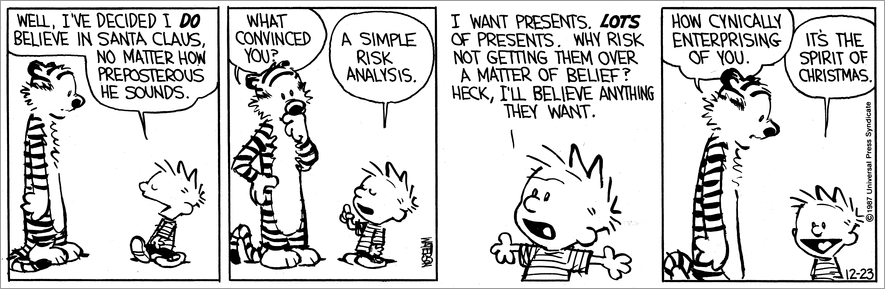
Aside from being my personal favourite comic, Calvin and Hobbes is one of the most popular comic strips of all time, both because of its enrapturing storytelling and its brilliant philosophical influences. It follows the childhood adventures of six-year-old Calvin, who is just as precocious as he is rambunctious, and his stuffed tiger Hobbes. And while these quirky and lovable title characters can be taken as nothing more than such, it's certainly no coincidence that their namesakes are 16th-century theologian John Calvin and 17th-century English philosopher Thomas Hobbes. There are countless examples of strips that have underlying academic themes, and the following is one of my (many) favourites. 


Watterson, Bill - Calvin and Hobbes (23 Dec 1987) | WIST


Leave it to Calvin to perfectly outline a 400-year-old metaphysical concept. 


Pascal's Wager is an argument presented by French theologian Balise Pascal, which suggest that one's belief in God is a bet on their own life. Essentially, the theory states that everyone should live as though God does exist because if they're wrong, they'll only have a finite loss but if they're right, they'll be rewarded infinite gains and avoid suffering from infinite punishment.


God exists

God does not exist

Belief in God

Eternal Joy

Nothing

Atheism

Eternal Suffering

Nothing


That being said, believing in God for the sake of believing in God is like being "good for goodness' sake." If your intentions behind "being good" are selfish in nature, such as being a means of waking up to presents on Christmas morning, then are you really "being good" at all? Even if it's logically sound and ultimately rewarding to believe in God, Pascal's reasoning is void of substance, and in order for someone to truly believe in anything, let alone a Supreme Being, I think there must be reason beyond personal gain. In the comic strip, Calvin doesn't necessarily believe in Santa per say; he merely believes in his own wants. 


For thousands of years, religious faith has been vehemently supported by some and dismissed with just as much vehemence by others. There are a few key arguments in support of God's existence, but as is the case with any philosophical debate, each argument opens up for a world of challenges and critiques. 


The Cosmological Argument

The cosmological argument, which was supported by Plato and Aristotle, is most often presented in terms of four "truth" clauses, the last of which stating the existence of God. Without excessive detail, the entire argument can be boiled down to the laws and standards of cause and effect. The clauses are as follows:

  1.  Every finite and dependent being has a cause.
  2. Nothing finite and dependent can cause itself.
  3. A casual chain cannot be of infinite length.
  4. Therefore, there must be a "first cause."

The Ontological Argument

The ontological argument is a little different. It was presented by Saint Anslem, and in simplest terms, is the idea that God exists because you can imagine God exists. Like the cosmological argument, it can be presented in terms of a number of clauses, the last of which stating the existence of God. Where the ontological argument differs however, is that it relies on the acknowledgement of four principle qualities that God must exhibit in order to be God. God must be omnipotent, God must be omniscient, God must be all-good, and God must exist. If those four qualities can be generally agreed on as conditional, then the clauses of the ontological argument can follow.

  1. God is a being than which none greater can be imagined.
  2. God exists as an idea of the mind.
  3. A being that exists as an idea in the mind and in reality is greater than a being that exists only as an idea in the mind.
  4. Thus, if God exists only as an idea in the mind, then we can imagine something that is greater than God.
  5. But we cannot imagine something that is greater than God, for it is a contradiction to suppose that we can imagine a being greater than the greatest possible being that can be imagined.
  6. Therefore, God exists.

The Teleological Argument

The teleological argument was suggested and supported by Saint Thomas Aquinas. It supposes that the universe is so complex that it requires a maker in order to make sense of its existence, and that there is no way it could have been created by chance rather than by design. The teleological argument can be argued in terms of the anthropic principle, which is the philosophical premise that any data humans collect about the universe and its creation must be filtered by the fact that in order for it to be observable in the first place, it must be compatible with the existence of conscious human life. In simpler terms, theories of the universe must allow for human existence, and the presence of a Supreme Being is one of the few explanations that account for this necessity. 

Take the Big Bang theory for example. In order for the Big Bang to have resulted in the creation of anything, let alone in the creation of sentient life, its explosive force had to be within 1 part in 10^60th of what it actually was. The percentage difference in the force of the Big Bang that could have still accommodated the possibility of life was literally 0.000000000000000000000000000000000000000000000000000000000001%. If it had been any weaker, the universe would have instantly collapsed in on itself due to gravity, and if it had been any stronger, its particles would have dispersed into thin air. Humanity's existence is like a house of cards: it's so improbable that if one single piece were removed or changed, the entire structure would fall apart. To me, God is the only explanation.

The Argument For Morality

In my opinion, the argument of morality is one of the most convincing. It suggests that because humanity has at least some innate morality, God must exist. It's summarized by C.S. Lewis in his Mere Christianity: "conscience reveals to us a moral law whose source cannot be found in the natural world, thus pointing to a supernatural Lawgiver." Oftentimes an individual's sense of morality opposes their personal interests and desires, and even if one doesn't follow their morality, there's almost always an inherent sense of guilt that accompanies that decision. Without a "supernatural Lawgiver," a human being's only inclination would be towards their own personal fulfillment.


* * * * * 


Of course, all of these arguments can and have been refuted in many ways by many people. I'm sure you've heard, or maybe even used the age-old "if God is so powerful, can he create a mountain so heavy he couldn't move it?" rebuttal. Besides, if God exists, why is there so much hurt in the world? What about free will? Or hate crimes committed in God's name? Some of these questions will be answered from my perspective in the weeks to come, and some of them won't. But ultimately, I feel that at the core of my being, there's inviolable love, life, morality, and purpose that surpasses own judgement, and even though there are still questions left unanswered and mysteries left unknown, that's why I believe in God.

Friday, September 4, 2020

Reasons Why "I Think; Therefore I Am" Is Fundamentally Flawed (Perspectives Part 1)

September 04, 2020 3

The month of August, although it has been taxing at times, has also been pretty eventful in terms of my academics (though I can't say the same about the productivity of my blog). I took an online Intro to Philosophy course as well as two RCM exams, and even though I would have liked to keep up my writing in the meantime, I was fairly swamped as it was. The chaos of the past few weeks is finally starting to die down though, and I thought I would ease back into Reasons Why with a blog series called Perspectives, outlining my personal perspectives as well as the perspectives of other scholars on a few of the metaphysical, epistemological, and ethical concept I learned about in my philosophy course this summer. I found the nature of the course's required readings especially fascinating because when combined, they read more-so as conversations rather than objective texts. Each successive paper built on the last, whether deliberately or coincidentally, and it was highly fulfilling to indulge in that on-going discussion with my own opinions and beliefs. I can only hope that this blog series will serve as an invitation to partake in the conversation yourself, because it's certainly a worthwhile one to have.


Learn Liberty | Happy birthday to René Descartes, father of methodological  skepticism


You may have heard of French philosopher Rene Descartes' famous-to-some-but-infamous-to-others statement: "cogito ergo sum," or perhaps more recognizably: "I think; therefore I am." This widely-debated declaration was first stated in Descartes' Meditations on First Philosophy, and has since been quoted, requoted, and misquoted time and time again. 


Descartes' was one of the first and most influential skeptics, and his objective in recording his meditations was to detach himself from any assumptions and beliefs that had reasonable cause for doubt, and consequently, to discover through logic and reasoning which elements of his experience truly existed. In order to do so, Descartes starts off his first meditation by unpacking some of the supposed absolutes that people often rely on as starting points for determining what is true. For example, he acknowledges that sensory experiences such as sight and touch are widely accepted as absolute truths, but he rejects sensory data as a reliable starting point because no sound evidence exists to prove that those experiences are not products of the imagination. Hallucinations and dreams can be just as engaging and stimulating to the senses as conscious encounters, but have no more validity than a story or a fairytale.


Once he has removed himself from the biases of doubtful absolutes, Descartes expands with his second meditation by taking a dualistic perspective (separating the human mind from the human body) and identifying the mind as the only indisputable basis for determining what is true. From this line of reasoning emerges Descartes’ “I think, therefore I am,” which refers to proof of existence based solely on the ability to form thought. 


Descartes' methods aren't convincing to me, but they do have their strengths, one of which being their acknowledgement that there are many things we accept as being true merely because we have been accustomed to accept them as such. Descartes insists on discovering a completely objective starting point—if such a thing exists— and eliminates as much bias from his reasoning as possible. That kind of objectivity is valuable because when people's beliefs are based solely on subjective constructs, they become unstable and unsound.


Another merit of Descartes’ method is its opposition of materialism. Materialism is the philosophical theory that nothing exists except that which can be experienced with the senses, and it presents a number of problems, the central one being that human societies rely on and are held together by unseen things— ethics, morality, justice, etc. Since Descartes believes the foundation of reality to be a product of the mind, he acknowledges the existence of the unseen, an acknowledgement that I consider to be highly valuable in navigating and fully grasping the world. 


Despite its strengths however, Descartes’ position, which is purely based on doubt and suspicion, has essentially created a closed feedback loop in that none of his beliefs can be reasonably disputed while still supporting his disbeliefs. Descartes opens by stating, “we may, generally speaking, doubt about all things and especially about material things, at least so long as we have no other foundations for the sciences than those which we have hitherto possessed.” His arguments disregard science, divinity, and sensory data, and are thus indisputable because any argument one may raise against his claims would have to appeal to one of those bases of knowledge to make its case. For example, a neuroscientist might argue that thoughts are the results of chemical reactions transmitted via the dendrites of neurons, which implies that they are no different than other forms of sensory data, but because Descartes starts off by discounting biological science, that kind of a rebuttal would be completely senseless. This philosophical method is contradictory however, because after disregarding physical sciences such as physics and medicine, Descartes goes on to use psychological sciences to prove his conclusion that the mind is the only absolute. He writes: “Arithmetic, Geometry and other sciences of that kind which only treat of things that are very simple and very general, without taking great trouble to ascertain whether they are actually existent or not, contain some measure of certainty and an element of the indubitable. For whether I am awake or asleep, two and three together always form five, and the square can never have more than four sides, and it does not seem possible that truths so clear and apparent can be suspected of any falsity.” Descartes chooses which sources of knowledge to accept and which ones to disregard based on whether or not they support his personal beliefs, and because of this, it is impossible to dispute his opinion. 


A number of philosophers have tried to refute however, including David Hume, Friedrich Nietzsche, and Baruch Spinoza— most of whom were monists (they believed that the human mind and the human body were unified and inseparable). Hume’s A Treatise of Human Nature suggests that there is no proof that one is the same “thinking thing” from one moment to another. Descartes states in his meditations: “I persuade myself that nothing has ever existed of all that my fallacious memory represents to me,” and Hume uses this admittance to the possibility that memories can be false to support his own opposing view. 


Additionally, Nietzsche's argument is formed around the fact that Descartes bases his evidence for existence on the thought processes in his mind because he has rejected external data as a grounds for proving existence. Nietzsche argued that internal thoughts cannot be separated from external data, because the only reason thoughts exist is because external data, such as social constructs and interactions, put them there.


Whether or not it is sound in reasoning though, the fundamental problem with Descartes' model is that it isn't the kind of philosophy one can live by, because it doesn't play out in day to day interactions. Descartes was a white, upper-class male in a society where he had the privilege to study and think about logic and philosophy, but personally I can't picture myself overlooking physical pain, fear, or heartache in any situation that really presented it. If Descartes were surrounded by hungry predators, caught in the hold of a capsizing ship, or trapped in a burning building, I doubt he would have the presence of mind to uphold that he "can't say for sure that [he] now sees the flames, hears the wood crackling, and feels the heat of the fire."


And that's why "I think; therefore I am" is fundamentally flawed.


Wednesday, July 29, 2020

Reasons Why the Titanic is Still on My Mind

July 29, 2020 0
As some of you will know, this is now the third installment of my unofficial Titanic series, over the course of which I've shared a vast array of facts, stories, conspiracy theories, and even creative writing. Needless to say, the "Unsinkable Ship" has left quite the impression on me, my writing, and my blog. But nevertheless, I feel I have yet to and may never— exhaust my material, and there are still a number of important Titanic-related things that need to be said. So prefaces aside, here are a few more of my favourite Titanic tidbits. There will almost assuredly be more to come. 

1. Robert Ballard 

Robert Ballard was an American professor of oceanography at the University of Rhode Island, whose dream was to find the Titanic wreckage. His long-anticipated search for the Titanic, however, wasn't funded until 1985 when the US Navy appointed him to locate and photograph two sunken submarines that were used during the Cold War, and allowed him to use the remainder of the budget to finance his hunt for the Titanic. During his search for the submarines, Ballard discovered a crucial piece of information which went on to essentially lead him straight to the sunken White Star liner. Traditionally, ocean explorers used sonar to search for wrecks,but in locating the submarines, Ballard realized that when a vessel sinks, it leaves a substantial trail of debris created by ocean currents, not unlike a comet's tail. The Titanic's trail of debris was an estimated 2km in length, and in discovering it, Ballard located the shipwreck in under 12 days. 

2. The Mummy Theory

An Ancient Egyptian artifact dubbed "the Unlucky Mummy" found its way aboard the Titanic, and according to urban legend, it cursed the liner and caused the demise of its passengers. The identity of the mummy's original owner varies from source to source, but after causing misfortune to its previous holders, it was reportedly donated to the British Museum in 1889, where it allegedly caused misfortune of a similar nature to staff and visitors. It was later bought by Journalist William Stead who, in attempt transport it to New York, hid the mummified body underneath the body of his car out of fear it wouldn't be admitted onto the Titanic due to its mysterious reputation. William Stead apparently revealed the mummy to other passengers the night before the disaster. 

3. David Blair

David Blair was a British White Star Line seaman who had been reassigned from his position as a crew member aboard the Titanic, not even a full day before its departure. Due to the last-minuteness of his reassignment, though, he (likely unintentionally) kept a key to a storage locker which is believed to have contained the binoculars that were to be used by the crow's nest lookout. From inaccessible binoculars to a cursed mummy on board, it seems as though the stars aligned for everything that possibly could have gone wrong to do so. 

4. Charles Joughin

To me at least, this story is one of the most unlikely and astounding. Chief baker aboard the RMS Titanic, Charles Joughin was one the 705 survivors. As nearly 1500 victims froze to death in the water around him, Joughin casually paddled around for over three hours until a lifeboat found him at dawn. Scientists have estimated that in the -2°C water, hypothermia should have started to set in after 15 minutes, and death no later than 30, yet somehow the baker survived for more than six times that length. His miraculous survival was since credited to the brandy he had consumed beforehand which supposedly heated up his body, although experts have debated the plausibility of that theory.

* * * * * 

And that's why the Titanic is still on my mind.

The Ottawa Bound Furniture That Went Down With Titanic | OTTAWA REWIND

Friday, July 24, 2020

"The Declan Miller Case" (A Short Story)

July 24, 2020 0
“Can I help you, uh… sir?”

“Detective Sergeant Calvin Bernard. Are you Miss Jones?”

“Y- yes, I am. Is anything the matter? It’s rather late for unexpected company.”

“I’ve been authorized to conduct an official eyewitness investigation into the Declan Miller case. Mind if I come in and ask you a few questions?”

“Not at all, officer. Make yourself at home.”

“Sergeant.”

“Pardon me?”

“I’m not an officer, miss. My name is Detective Sergeant Calvin Bernard.”

“Oh of course, my mistake.”

“Don’t worry ‘bout it, sweetheart. Now is there somewhere we can grab a seat? This might take a while.”

“I’ll bring you into the parlour. It’s down the— I can take your coat for you— it’s down the hall and to the left.”

“Sounds good. It’s a lovely place you’ve got here.”

“Thank you, sir.”

“Must get awful lonely.”

“I’m sorry?”

“Living here all by yourself, I mean. A girl like you could use some company.”

“With all due respect, I’ve been getting along just fine on my own.”

“Okay okay, I didn’t mean nothin’ by it. Why don’t we just get this testimony over with. I’ll lay my files out here.”

“Go ahead.”

“Right then. Let’s get into it. ‘At approximately 2300 hours on February 15, 2019, Dispatch notified the LVMPD of a potential homicide at 10801 W Charleston Blvd, second floor, which is currently being rented to the Howard Hughes Corporation. Upon arriving at the scene, uniformed officers’— and sergeant, obviously— ‘identified the body of victim Declan Miller, 43, who had been dead for an estimated 2 to 3 hours.’ Of course, none of this is news to you, now, is it Miss Jones?”

“No, sir.”

“Tell me, what are your affiliations with the Howard Hughes Corporation?”

“I’m their financial analyst. I have been for some time now.”

“Financial Analyst? Wonder what you had to do to get a job like that.”

“I beg your pardon?”

“Relax, I was only joking. Anyways, Declan Miller was a realtor for the company, yes?”

“That’s right.”

“What was his reputation in the office?”

“Well, I know a few of the women weren’t exactly… uh, comfortable around him. But he always seemed like a friendly face.”

“Elaborate.”

“Oh, you know. Some of the women would complain about inappropriate comments, nicknames, lack of boundaries, that sort of thing— oh sorry sir, could you keep your feet off the coffee table?”

“Sure thing, honey.”

“But I’ve worked with him for almost a decade now, and I’ve never really—”

“A decade? You must be what, 30? 35? You look good for your age.”

“Um thank you, sir. But as I was saying, I’ve never really had any issues with Mr. Miller.”

“I see. What about his relationship status? I interviewed Julie not long ago, and she said she—”

“Pardon me, sir, but Julie?”

“Janet? Jenny? Oh I don’t know, the secretary.”

“Jane?”

“Jane. Anyways, she said the two of them—Jane and Declan, that is— had been on again off again for a couple years. What did you know about their relationship?”

“Not much, sir. They broke up a few days before Valentine’s Day, but I never really knew why. I did overhear them arguing a few weeks prior though.”

“Did you catch what it was about?”

“Not really. I think she accused Mr. Miller of flirting with his clients or something. I can’t say for certain, but I think she was suspicious of his late nights at the office.”

“So it sounds like Julie started the—”

“Jane.”

“It sounds like Jane started the argument. Were they on good terms the night of the murder?”

“I don’t believe so. She didn’t show up to work that morning.”

“Interesting. And what can you tell me about Declan’s reputation with the rest of the employees?”

“Oh, Mr. Miller’s always been quite popular in the office. Well until his promotion, that is.”

“Promotion?”

“He deserved it, don’t get me wrong. But I think a few of the other realtors were also expecting it, and he didn’t exactly try to hide his excitement.”

“I see. Anyone stick out in your mind as being particularly bothered?”

“I think everyone was a little annoyed, offi— um, sergeant. But now that you mention it, one of the real estate agents—Jacob Wright— seemed especially off-put.”

“Tell me about this Jacob Wright.”

“I could be mistaken, but I believe he and Mr. Miller were once good friends. At least, they used to take lunch breaks together, and I’m pretty sure they’ve carpooled to work a few times.”

“And you noticed a shift after the promotion?”

“Yes, sir. I don’t think Mr. Wright was doing too well, and I imagine he could have used the pay raise.”

“What gave you that impression?”

“Well, you know how word gets around. I heard through the grapevine that he lost his wife not long ago, and if I’m not wrong, that would make him a single father to three teenage daughters and a newborn. I can’t help but feel sorry for him.”

“When was the promotion announced?”

“I think it was two days before the night of the murder. The thirteenth? I don’t remember exactly.”

“I see. And where were you that night, Miss Jones?”

“Which night, the thirteenth? I had taken the day off to help my sister with some—”

“Not the thirteenth, miss. Where were you the night of the murder?”

“At work, sir”

“For how long?”

“Nine to five.”

“Then what?”

“Straight back here.”

“When did you arrive?”

“5:20.”

“How?”

“By bus.”

“How come?”

“My car’s in for repairs.”

“And you went back to the office later that night? Why?”

“I forgot my purse at my desk.”

“And so you took the bus back to work, rode the elevator to the second floor, unlocked the door, turned on the lights—”

“And found Mr. Miller face down on the carpet. Sorry sir, but may I ask something?”

“What is it?”

“There's been an autopsy, no? Has it revealed anything?”

“Let's leave the investigating to the professionals, darling.”

“Sorry. It’s just that there wasn’t any blood or anything. No sign of a struggle. I figured it must’ve been a heart attack, but when the word ‘homicide’ was all over the news the next day, I couldn’t help but wonder.”

“Well, I’ll tell you this much. This was certainly no accident.”

“What do you mean?”

“I’ll let you in on a little secret.”

“What’s that?”

“Anthrax.”

“Anthrax?”

“Anthrax. Bacillus anthracis. The stuff’s deadly.”

“I’m not sure I follow.”

“You wouldn’t, sweetheart. Someone’s been lacing it into his clothing.”

“His clothing?”

“Most likely the sleeves of his jacket. He had blisters the size of golfballs running up and down the length of his arms.”

“Who would do such a thing? And why?”

“That’s what we’re trying to figure out.”

“How soon do you think it’ll be until we get some answers?”

“Could be days. Could be a matter of weeks. You okay, miss?”

“Sorry, this is just a lot to take in.”

“I bet you wouldn’t mind some company tonight.”

“Excuse me?”

“I’m free to stay for a while. We could—”

“I’ll walk you to the door.”

“Fine, whatever you want.”

“Oh, you almost forgot your coat. I’ll grab it for you. Wait one moment.”

“Sure.”

“There you are.”

“Much obliged. Good night, Miss Jones.”

“Good bye, Sergeant Bernard.”


Wednesday, July 22, 2020

Reasons Why Growing up a Gifted Kid Isn't Always What It's Cracked up to Be

July 22, 2020 2
Definitions of gifted education vary from source to source. My school board's Ministry of Education, for instance, defines it as "accommodating learning experiences of a depth and breadth beyond those normally provided." Some of my more cynical friends, however, have described it as "when you take a test that dictates the next ten years of your life despite being too young to even pack your own lunch." Although the former may be more credible and the latter more biased, neither of these definitions are necessarily more factual than the other, and based off my own personal experiences as part of an enriched education program, I think the answer lies somewhere in between.

For me, along with most of the students from my old public school, the Giftedness Battle of Identity started on the playground at a young age. See, our school had a number of self-contained enriched classes mixed in with the general education ones, so even though everyone went to the same school, you would rarely see kids from the opposite program. And maybe it was because we were naturally inclined to befriend our own classmates, or maybe it was because we had these labels attached to us like ear tags on a herd of cattle. Whatever the reason, every recess became a war between the "Gifties" and the "Normies," as we had designated ourselves. There was this student-contrived invisible line that partitioned the school yard, and the "Gifties" and the "Normies" kept to their respective sides.

It's hard to blame our 9-year-old selves, though. Being in the gifted program and being in the mainstream program was made to be such a seemingly substantial part of our identities. Not only did the entire school dynamic seem to support the disconnect, but also when you're a kid you don't have much else to identify with; there's your name, your grade, your gender, and in our case, whether you're "gifted" or "mainstream."

And I think those terms are the root of the problem when it comes to enriched education. I grew up not thinking twice about the word "gifted," but if you really take a step back and consider the implications of that language, they become difficult to look past. I mean, what does it mean to be gifted? What does it mean to have a gift?

Well, my school board's web page implies that "an unusually advanced degree of general intellectual ability" is a gift. The test I took when I was 9 implies that creative thinking and the ability to make broad connections are gifts. My teachers' approach implies that superiority in math and excellence in language are gifts.

But those are just a few (exclusionary) examples of the very real and the very necessary gifts in our world. I have a sibling who wasn't accepted into the gifted program but is exceptionally talented in the arts. I have another friend who wasn't accepted but is a natural leader and an efficacious public speaker. And that's not to mention those with spiritual gifts: discernment, hospitality, intercession, etc. Can any of those people be justly labelled as ungifted just because they aren't in the fifth percentile for elementary school math?

When I grew up, there was so much social stigma attached to the "mainstream" program. But oftentimes the product of a graduating gifted class is a few students who go on to achieve conventional success, and a few who fall victim to what I like to call the Gifted Kid Cycle, which plays out something like this:

Students will spend the first and statistically most definitive 10 years of their lives contending with the same class of mark-oriented geniuses, which makes them liable to becoming competitive perfectionists. They spend those same years intensively studying the subjects that come naturally to them, meaning they never have to exert themselves to succeed. And so, these predisposed competitive perfectionists also never learn how to fail, and are thus unmotivated to try.

Despite this lack of motivation though, they live their lives desperate to live up to the potential and the pressure (both internal and external) that they experienced during their entire life tagged as a gifted kid.

So while the gifted program is presented as an environment that sets you up to prosper, and often succeeds at doing so, that isn't always the case. The National Association for Gifted Children identifies heightened awareness, anxiety, perfectionism, stress, issues with peer relationships, and identity concerns as possible effects of gifted education that students occasionally carry with them into adulthood.

While I recognize the undeniable importance of accelerated education for certain students, there are all sorts of other factors at play, and the program is far from perfect. And that's why growing up a gifted kid isn't always what it's cracked up to be.

How to Nurture a Gifted Child, From the Longest-Running Study on ...