Showing posts with label religion. Show all posts

Friday, October 2, 2020

Reasons Why Nietzsche Pegged Us All For Murderers (Perspectives Part 5)

October 02, 2020 3

One fateful Saturday afternoon last December, I was driving through a thick Canadian winter snowfall to the dress rehearsal of a holiday concert that I had rehearsed diligently in another city, but regrettably never in the town that was host to this particular rehearsal. That's how it came to be that I was driving down an unfamiliar highway, heading into an unfamiliar part of the country, with GPS directions that I was altogether unfamiliar with. Whether it was simply a coincidence or it was a result of divine providence, I happened to be carpooling with one of the other performers that day, so I wasn't completely alone when I took the wrong turn off the highway and steered my ill-fated little Kia Forte onto an old country road. My friend and I didn't notice at first, but as we travelled further and further down the lane, the road got narrower and narrower and the snow got deeper and deeper, until turning around was completely out of the question. See, although it was unbeknownst to the two of us at the time, Google maps hadn't turned me onto a public-use roadway at all, but rather onto the ill-maintained entrance to a provincial park. Somehow I had missed the "WARNING: NO WINTER-MAINTENANCE" signs that had been posted along the path, and my friend and I wound up stranded in what felt like two or more feet of snow in the middle of nowhere.


And you may think that's bad enough, but buckle up (car pun intended), because this story is just getting started.


After spending a good hour or so pushing, digging, reversing, and pushing some more, my friend and I finally came to terms with the reality that we didn't have the strength, knowledge, or tools to get out of the wintry ditch by ourselves. Resorting to our cellphones, we discovered that the battery on mine had been completely drained from the cold, and my friend's wasn't getting any service from the middle of the forest. And so having no other option, we left our car, half-submerged in snow as it was, and walked aimlessly up the frozen pathway in search of either cell reception or human contact, whichever came first. 


Perhaps it comes as no surprise, considering we were on a summer hiking trail a few days from Christmas, but cell reception came long before human contact. After walking for about ten minutes in the bitter cold, we picked up barely a bar of service and got through to my dad. Then it was up to him to decipher our situation based on our low-quality call for help, map out our location based on our directional oblivion, and come to our rescue. Almost two hours, three shovels, and half a tank of gas later, and my Kia was free from its snowy confinement.


Now although I didn't realize it in the moment, while I was frantically shoveling snow out of the wheels of my immobilized car, my accidental adventure was actually the perfect analogy for how 19th-century German philosopher Friedrich Nietzsche considered the Age of Enlightenment to have influenced the concept of God in Western civilization.


You may have heard of Nietzsche's God Is Dead before. The statement first appeared in 1882 and has since become one of the most popular and well-known philosophical excerpts from throughout history. It's been misquoted, or at least misinterpreted, time and time again, and its implications are widely debated. Because while the title lends itself to setting up the plot for some kind of religious family/drama coming-of-age film, Nietzsche had very different intentions that are frequently overlooked.


"God is dead. God remains dead. And we have killed him."

In order to fully grasp the implications of God Is Dead, it's important to first consider the historical time period during which Nietzsche wrote. See, Nietzsche's philosophical model was most prevalent around the turn of the twentieth century, during which culture had started moving towards a place where a collective belief in God held less relevance, and society didn't need religion to explain things like creation or human origin. As you may recall from last week's blog post, the concept of Darwinism became prominent in the 1870s, and along with other new scientific concepts and technological advances, God was no longer the foundation of society like it had been in previous centuries.


So when Nietzsche claims so assuredly that God is dead, and accuses so convincingly that we have killed him, it isn't to say that we have literally murdered a physical being, but rather that our changing principles have made a belief in God irrelevant. God Is Dead isn't the set-up to a murder mystery, but rather an account of a steady rise of secularity and abandonment of traditional beliefs.


"How shall we comfort ourselves, the murderers of all murderers? What was the holiest and mightiest of all that the world has yet owned has bled to death under our knives."

After dropping the bombshell that was his first sentence, Nietzsche goes on to establish why it matters. God is dead, so what? 


Well, God was "the holiest and mightiest of all that the world has yet owned." The influences of religion were the foundation of meaning, morality, purpose, and even aesthetic beauty for centuries. Once those principles become irrelevant, there's no longer a universal truth, and without God, we're left without a way of determining right from wrong. How can humans atone for this huge gap in meaning that the death of God has left?


 "Who will wipe this blood off us? What water is there for us to clean ourselves? What festivals of atonement, what sacred games shall we have to invent? Is not the greatness of this deed too great for us? Must we ourselves not become gods simply to appear worthy of it?"

According to Nietzsche, human beings must step up to fill in for God, and find in themselves their own answers to meaning, truth, beauty, and morality. This position was a monumental shift in the functionality of human cultures, because throughout history up to this point, sacred scripture and tradition was believed to have shown human beings how they were supposed to live. There was a widely accepted absolute truth of right and wrong, and without a belief in God, people needed to come to those things on their own.

Last year, when I got lost in the middle of the forest because my GPS failed, my cell lost reception, and my phone battery died, I was forced to stop looking to technology for answers, and to start following my own two feet down the snowy country road I had been stranded on. I needed to come to directions on my own without a consistent, dependable, omniscient-in-terms-of-street-maps machine to tell me where to go and what to do. Nietzsche probably wouldn't have put it in quite these terms (especially considering his limited knowledge on smartphones), but in the same way that my GPS died, leaving me lost and directionless in a snowy ditch, society's mutual acknowledgement of God has died, leaving humankind in an existential, nihilist ditch. 

This ties into Nietzsche's concept of Ubermensch, or the superman, which is his conclusion that the ideal man, the superior man, was one who rises above conventional traditions and morality to create and impose his own values. And although there isn't anything inherently wrong with this principle, it ended up being used to influence and justify a lot of unspeakably horrifying things: things like mass genocide, terrorism, and war. Because if there's no absolute truth in God and morality comes from each individual's personal values and principles, then what's to stop someone like Hitler from presenting their actions as mere exhibitions of their own personal truths? 

So whether it's for better or for worse (or somewhere in between), humans are collectively moving their lifestyles in different directions, directions that are guided not by sacred writing nor by religious practice, but rather by personal instinct and intuition.

And that's why Nietzsche pegged us all for murderers.

Friday, September 25, 2020

Reasons Why We Should Believe in Free Will Whether It Exists Or Not (Perspectives Part 4)

September 25, 2020 2

One of the assignments from the philosophy course I took this summer was to design a philosophical comic strip that outlined a key metaphysical concept of our choice. Now, I'm no Bill Watterson but between my limited comedy writing skills and my best friend's compensating artistic talent, this is what we were able to come up with. 


Hopefully it goes without saying, but the philosophical concept I chose to comicize was determinism, which along with the concept of free will and the perhaps less-well-known theory of compatibalism, has drastic implications both on the future, as well as on each individual's present, daily lives.


You've probably heard of free will before it's the theory that human beings have the ability to make their own conscious choices that have influence over the future. Free will permits us to act at our own discretion without the constraints of necessity or fate. 


Determinism on the other hand, is the idea that all our choices are already predetermined, and that there is nothing anyone can do to change the past, present, or future. There are a couple different approaches to determinism, including causal determinism which theorizes that cause and effect relationships invariably lead from one to the other to determine the future, theological determinism which theorizes that a God determines the future, and biological determinism which concludes that the genetic programming of living creatures establishes everything they do, which consequently determines the future. Each of these methods differs from the others, but fundamentally, they all suggest an external influence, independent from human will, that has authority over human action and human thought. 


And if you're having trouble coming to terms with the implications of free will or determinism, perhaps you'll be more inclined to adopt compatibilism, which in simplest terms, is a compromise between the two theories. A compatibilist would suggest that humans get a small amount of options in an essentially determined universe. If the universe was a road trip, compatibilism might allow you to choose the radio station and snacks for the drive, even though you have no say in the destination.


The Determinist Argument

One of the first defenses of determinism was published by mathematical physicist Pierre-Simon Laplace in 1814. It was a thought experiment called Laplace's Demon. In order to prove determinism, Laplace proposed that if a someone (in his example, a demon) were capable of knowing the precise location and momentum of every single atom in the universe, their past and future could be calculated by the laws of classical mechanics and cause and effects. Like many other mathemacian philosophers, Laplace believed that the randomness we perceive is simply an epistemic consequence of human ignorance, and that free will is an illusion born from complexity. 

Laplace's Demon, although it is thought-provoking, isn't backed up by any meaningful evidence beyond Laplace's assumptions. Since 1814 however, determinists have become more determined than ever to provide sufficient arguments. 


The sufficiency of these arguments began to emerge about 150 years ago with the intellectual revolution that accompanied the publication of Charles Darwin's On the Origin of Species. Because even though Darwin's work never explicitly states the implications that his theory of evolution has on free will and determinism, they were drawn out by his cousin, Sir Francis Galton. Galton concluded that if we have evolved, then mental faculties like intelligence must be hereditary. But we use those faculties to make decisions, so our ability to choose our fate is not free, but depends on our biological inheritance.


More recently, neuroscience research on the inner workings of the brain has conducted further investigation to Galton's theory. Modern brain scanners now allow us to look inside a living person's skull, revealing intricate networks of neurons that determine our thoughts, hopes, and memories. Thanks to this technology, neuroscientists have reached a general consensus that these networks are shaped both by genes and environment.  And American psychologist Benjamin Libet took this discovery one step further in the 1980's when he proved that the electrical activity that builds up in a person's brain before they, say, move their arm, occurs before the person even makes the conscious decision to move.


If these arguments are too technical, many determinists consider how changes to brain chemistry can alter behaviour. Between alcohol and antipsychotics— not to mention the way fully-matured adults can become murderers or pedophiles after developing tumors in their brains— human decisions can clearly be effected by chemical balances in the brain, and thus many argue that humans are dependent on the physical properties of their grey matter and nothing more.


The Free Will Argument

A lot of free will adherents would call on German philosopher Immanuel Kant's arguments against determinism, which touch on a concept that the Christian tradition would label our "moral liberty." Essentially, humans have an undeniable innate obligation to chose between right over wrong, which is made apparent through the inherent guilt we feel when we neglect that duty, and as Kant put it, "if we are not free to choose, then it would make no sense to say we ought to choose the path of righteousness." Of course, some would suggest that we don't ought to choose the path of righteousness, but this counterargument is simply ignorant to the structures our society is based on. Incarceration systems, the Nobel Peace Prize, and everything in between is more or less established on a universal accountability for doing the right thing.


But moral liberty aside, one of the biggest problems I have with determinism is that it contains a logical fallacy. The fact that a determinist would even attempt to convince others of their position shows that they rely on the free will and volition of the people they are trying to convince. The theory of determinism implies that everything, including an individual's thoughts and beliefs, are determined by some kind of preexisting cause, which means it would be impossible to change another person's stance.


* * * * * 


As you're probably discovering, free will and determinism are far more complex and far less fathomable than they're often credited as. But whether you're compelled by the implications of the free will argument, convinced by the assertions of the determinist argument, or merely disoriented and confused by it all, assumptions of free will run through every aspect of our lives. From politics, welfare provisions and incarceration to world sports championships and Academy Awards, a general acceptance of free will is the foundation for a functioning society. I mean, can we really justify imprisoning criminals for crimes they had no choice but to commit? And are anyone's accomplishments truly deserving of praise if they were simply predetermined? Even the century-old American dream— the belief that anyone can make something of themselves regardless of their start in life— is entirely based on the ideals of conscious, intentional choice.


The importance of free will also transcends society's constructs, and appertains to individual moral conduct. A 2002 study was conducted by psychologist Kathleen Vohs and Jonathon Schooler, in which one group of participants was asked to read a passage arguing that free will was false, and another group was given a passage that was neutral on the topic of free will. Each group was then asked to perform a number of tasks (eg. take a math test in which cheating was made easy, or hand in an unsealed envelope full of loose change), and the participants who were conditioned to deny free will were proven more likely to behave immorally.


There is advantage to regarding free will as real, not because it is necessarily true (although I believe it is), but because, in the words of Barack Obama, "values are rooted in a basic optimism about life and a faith in free will."


And that's why we should believe in free will whether it exists or not.

Friday, September 11, 2020

Reasons Why I Believe in God (Perspectives Part 2)

September 11, 2020 4

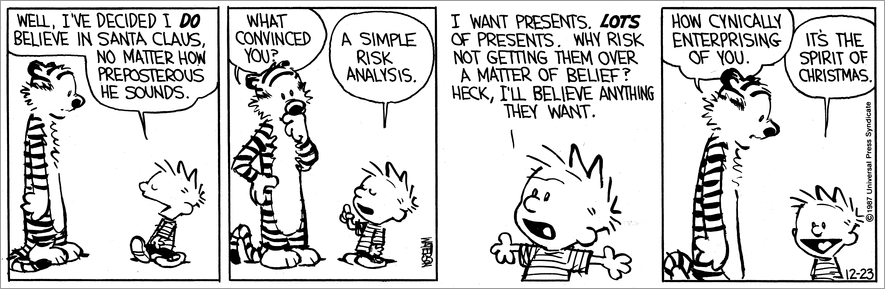
Aside from being my personal favourite comic, Calvin and Hobbes is one of the most popular comic strips of all time, both because of its enrapturing storytelling and its brilliant philosophical influences. It follows the childhood adventures of six-year-old Calvin, who is just as precocious as he is rambunctious, and his stuffed tiger Hobbes. And while these quirky and lovable title characters can be taken as nothing more than such, it's certainly no coincidence that their namesakes are 16th-century theologian John Calvin and 17th-century English philosopher Thomas Hobbes. There are countless examples of strips that have underlying academic themes, and the following is one of my (many) favourites. 


Watterson, Bill - Calvin and Hobbes (23 Dec 1987) | WIST


Leave it to Calvin to perfectly outline a 400-year-old metaphysical concept. 


Pascal's Wager is an argument presented by French theologian Balise Pascal, which suggest that one's belief in God is a bet on their own life. Essentially, the theory states that everyone should live as though God does exist because if they're wrong, they'll only have a finite loss but if they're right, they'll be rewarded infinite gains and avoid suffering from infinite punishment.


God exists

God does not exist

Belief in God

Eternal Joy

Nothing

Atheism

Eternal Suffering

Nothing


That being said, believing in God for the sake of believing in God is like being "good for goodness' sake." If your intentions behind "being good" are selfish in nature, such as being a means of waking up to presents on Christmas morning, then are you really "being good" at all? Even if it's logically sound and ultimately rewarding to believe in God, Pascal's reasoning is void of substance, and in order for someone to truly believe in anything, let alone a Supreme Being, I think there must be reason beyond personal gain. In the comic strip, Calvin doesn't necessarily believe in Santa per say; he merely believes in his own wants. 


For thousands of years, religious faith has been vehemently supported by some and dismissed with just as much vehemence by others. There are a few key arguments in support of God's existence, but as is the case with any philosophical debate, each argument opens up for a world of challenges and critiques. 


The Cosmological Argument

The cosmological argument, which was supported by Plato and Aristotle, is most often presented in terms of four "truth" clauses, the last of which stating the existence of God. Without excessive detail, the entire argument can be boiled down to the laws and standards of cause and effect. The clauses are as follows:

  1.  Every finite and dependent being has a cause.
  2. Nothing finite and dependent can cause itself.
  3. A casual chain cannot be of infinite length.
  4. Therefore, there must be a "first cause."

The Ontological Argument

The ontological argument is a little different. It was presented by Saint Anslem, and in simplest terms, is the idea that God exists because you can imagine God exists. Like the cosmological argument, it can be presented in terms of a number of clauses, the last of which stating the existence of God. Where the ontological argument differs however, is that it relies on the acknowledgement of four principle qualities that God must exhibit in order to be God. God must be omnipotent, God must be omniscient, God must be all-good, and God must exist. If those four qualities can be generally agreed on as conditional, then the clauses of the ontological argument can follow.

  1. God is a being than which none greater can be imagined.
  2. God exists as an idea of the mind.
  3. A being that exists as an idea in the mind and in reality is greater than a being that exists only as an idea in the mind.
  4. Thus, if God exists only as an idea in the mind, then we can imagine something that is greater than God.
  5. But we cannot imagine something that is greater than God, for it is a contradiction to suppose that we can imagine a being greater than the greatest possible being that can be imagined.
  6. Therefore, God exists.

The Teleological Argument

The teleological argument was suggested and supported by Saint Thomas Aquinas. It supposes that the universe is so complex that it requires a maker in order to make sense of its existence, and that there is no way it could have been created by chance rather than by design. The teleological argument can be argued in terms of the anthropic principle, which is the philosophical premise that any data humans collect about the universe and its creation must be filtered by the fact that in order for it to be observable in the first place, it must be compatible with the existence of conscious human life. In simpler terms, theories of the universe must allow for human existence, and the presence of a Supreme Being is one of the few explanations that account for this necessity. 

Take the Big Bang theory for example. In order for the Big Bang to have resulted in the creation of anything, let alone in the creation of sentient life, its explosive force had to be within 1 part in 10^60th of what it actually was. The percentage difference in the force of the Big Bang that could have still accommodated the possibility of life was literally 0.000000000000000000000000000000000000000000000000000000000001%. If it had been any weaker, the universe would have instantly collapsed in on itself due to gravity, and if it had been any stronger, its particles would have dispersed into thin air. Humanity's existence is like a house of cards: it's so improbable that if one single piece were removed or changed, the entire structure would fall apart. To me, God is the only explanation.

The Argument For Morality

In my opinion, the argument of morality is one of the most convincing. It suggests that because humanity has at least some innate morality, God must exist. It's summarized by C.S. Lewis in his Mere Christianity: "conscience reveals to us a moral law whose source cannot be found in the natural world, thus pointing to a supernatural Lawgiver." Oftentimes an individual's sense of morality opposes their personal interests and desires, and even if one doesn't follow their morality, there's almost always an inherent sense of guilt that accompanies that decision. Without a "supernatural Lawgiver," a human being's only inclination would be towards their own personal fulfillment.


* * * * * 


Of course, all of these arguments can and have been refuted in many ways by many people. I'm sure you've heard, or maybe even used the age-old "if God is so powerful, can he create a mountain so heavy he couldn't move it?" rebuttal. Besides, if God exists, why is there so much hurt in the world? What about free will? Or hate crimes committed in God's name? Some of these questions will be answered from my perspective in the weeks to come, and some of them won't. But ultimately, I feel that at the core of my being, there's inviolable love, life, morality, and purpose that surpasses own judgement, and even though there are still questions left unanswered and mysteries left unknown, that's why I believe in God.